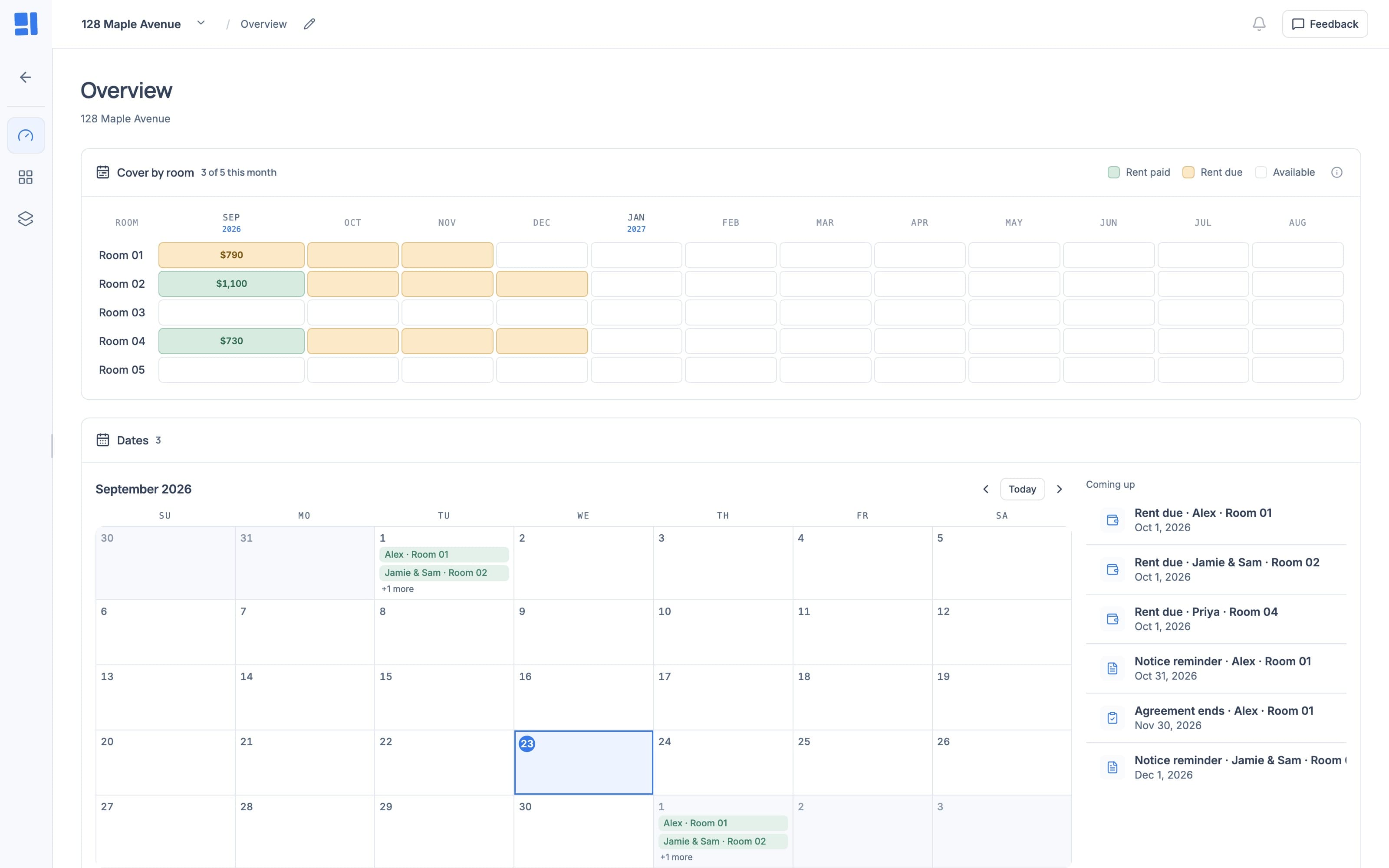
It’s October 31, the notice reminder on Alex’s Room 01 agreement, and nobody has actually asked Alex whether he’s staying. In a rent-by-the-room house, turnover happens one room at a time while everyone else keeps living there. That’s easier than emptying a whole house, but it’s just as easy to let slide: the notice date passes unnoticed, the listing goes up late, and a $790 room sits empty for three weeks. This guide walks one room from notice to move-in, with a worked timeline for Room 01 at Maple House and the arithmetic on what an empty week costs.
Confirm notice on the reminder date, list before the room is empty, keep move-out and move-in records separate, and plan the gap in days, because each empty week in a $790 room costs about $204.
The pipeline, in order
Every room turnover runs through the same eight steps. Most of them can overlap with the outgoing resident’s last month, and that overlap is where a turnover is won or lost. If you wait for the move-out to start pricing and listing, the room will sit empty for however long filling it takes.
The steps that slip most often are the first and the fifth: nobody confirms the notice in writing, and the listing goes up after the room is already empty.
- Notice given and confirmed in writing, or a renewal agreed
- Move-out walkthrough and condition record
- Deposit returned within your state’s deadline
- Cleaning and repairs finished
- Asking rent checked and the room listed
- Viewings scheduled with current housemates in mind
- New agreement recorded and signed
- Move-in walkthrough and condition record
What an empty week costs
Room 01 rents for $790 a month. Over a year that’s $790 × 12 = $9,480, or $9,480 ÷ 52 = $182.31 a week and $9,480 ÷ 365 = $25.97 a day.
The bills don’t stop when the room is empty. Maple House includes utilities, and in an average $480 month the equal share per room is $96, which the landlord covers while the room is empty. That’s $96 × 12 ÷ 52 = $22.15 a week. Together, an empty week in Room 01 costs about $204.
Put that next to the pricing guide’s numbers. The Maple House owner cushion is $300 a month, so two empty weeks, $408.92, wipe out more than a month of it. And the 92% occupancy buffer assumes about one empty month per room per year; a four-week gap in Room 01 uses all of it in one turnover.
| Gap | Lost rent | Utilities share covered | Total |
|---|---|---|---|
| 3 days | $77.92 | $9.47 | $87.39 |
| 1 week | $182.31 | $22.15 | $204.46 |
| 2 weeks | $364.62 | $44.31 | $408.92 |
| 4 weeks | $729.23 | $88.62 | $817.85 |
Worked timeline: Room 01 at Maple House
Alex’s Room 01 agreement ends November 30 and has a 30-day notice period, so the notice reminder falls on October 31. Alex is leaving. The goal is a new resident moving in on December 3, leaving two empty days for cleaning and small repairs.
With the plan below, Room 01 is empty on December 1 and 2, which costs about $58 using the daily figures above. If the same room were only listed after Alex moved out and took three weeks to fill, the gap would cost about 3 × $204.46 = $613.
| Date | Day | Step | Owner |
|---|---|---|---|
| Oct 31 | −30 | Notice reminder: confirm in writing whether Alex is renewing or leaving | Landlord |
| Nov 1 | −29 | Alex confirms move-out; book the move-out walkthrough for Nov 30 | Landlord and Alex |
| Nov 3 | −27 | Check the asking rent against current listings; post the listing | Landlord |
| Nov 4 | −26 | Tell Alex and the housemates the viewing windows for the month | Landlord |
| Nov 8–19 | −22 to −11 | Viewings in set windows; screen applicants with your provider | Landlord |
| Nov 21 | −9 | Choose the next resident; record a draft agreement starting Dec 3 | Landlord |
| Nov 30 | 0 | Move-out walkthrough with Alex; keys back; move-out condition record | Landlord and Alex |
| Dec 1–2 | +1 to +2 | Clean, touch up paint, fix what the walkthrough found | Landlord, cleaner, contractor |
| Dec 3 | +3 | Move-in walkthrough and condition record; new agreement starts | Landlord and new resident |
| Your state’s deadline | — | Return Alex’s deposit, with any deductions explained as required | Landlord |
- Before move-outConfirm the dates
Check the current agreement and schedule the room review.
- At handoverRecord the condition
Take dated photos and connect them to the outgoing agreement.
- Between occupantsResolve open work
Track repairs against the room, with a responsible person and status.
- At move-inStart a fresh record
Attach new evidence to the incoming agreement; keep the earlier set.
Notice and the move-out walkthrough
The agreement’s notice period decides when you need to know whether the room is turning over. Don’t assume: on the reminder date, ask the resident and get the answer in writing. If they want to stay, record a new agreement for the next term, starting the day after the current one ends, rather than stretching the old one’s dates. The minimum notice either side must give, and how it has to be delivered, is set by local law and your agreement.
Do the move-out walkthrough with the resident present if you can, and cover the same areas as the move-in record: the room itself and any shared areas you recorded then. Take dated photos, collect keys and any fobs or parking permits, and note the forwarding address for the deposit.
Be careful with shared areas. A scuffed hallway or a worn kitchen counter in a five-person house is hard to pin on one departing resident. Record the condition, but decide on deductions from the agreement and your local rules, not from one set of photos.
Deposit, cleaning, and repairs
Deposit return deadlines, what can be deducted, and whether deductions must be itemized are set by state and sometimes city law, and they vary widely. Look up your rule before the move-out date, put the deadline on your calendar, and ask your attorney if anything is unclear. This guide doesn’t give deadlines for that reason.
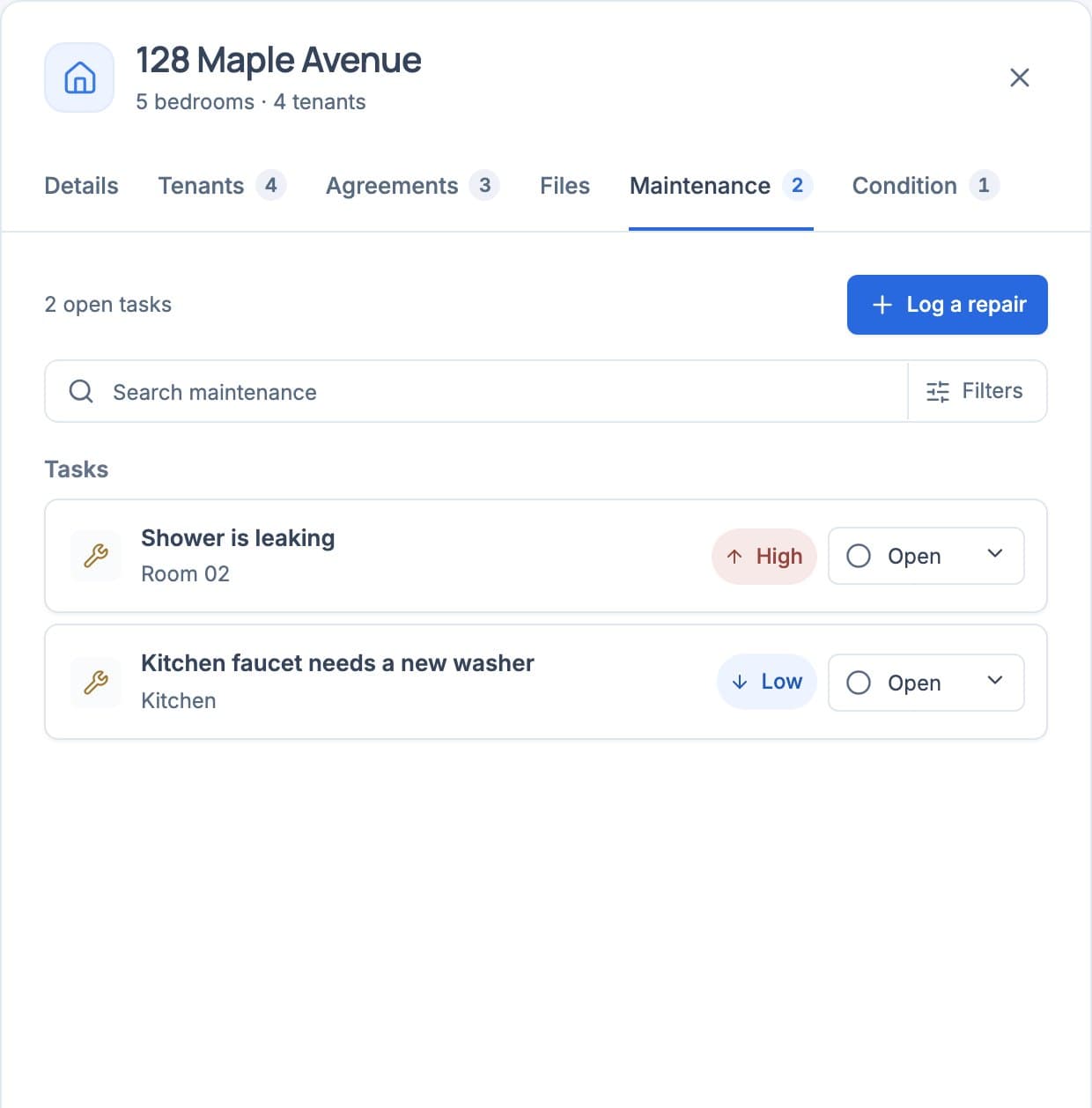
Turn walkthrough notes into repair tasks on the room the same day, and fix anything that blocks a move-in first. Book the cleaner and any contractor before move-out day, not after; a two-day gap only works if the work is already scheduled.
- Change the lock or door code, and account for every key
- Test the smoke and carbon monoxide alarms in and near the room
- Deep clean the room, including windows, closet, and under the bed
- Patch and touch up paint where the walkthrough flagged it
- Check furniture, mattress, and blinds if the room is furnished
- Clear the room’s fridge shelf and cupboard for the next resident
Pricing, listing, and viewings with housemates at home
Turnover is the right time to review the asking rent, because you’re changing it between agreements rather than in the middle of one. Weigh any increase against time on the market. Raising Room 01 by $20 a month adds $20 × 12 = $240 a year, which is about 1.3 empty weeks at $182.31. If the higher price takes more than an extra week to fill, it loses money in the first year.
Viewings happen in someone’s home. Give Alex notice before showing the room, following the agreement and local entry rules, and bundle viewings into two or three set windows so the house isn’t interrupted every evening. Tell the other residents when viewings are, and show applicants the house rules before they apply, not after.
It’s common to let housemates meet a finalist, but the decision is yours. Fair housing law applies to how you advertise and choose residents; use consistent written criteria and ask a local professional how the rules apply to shared housing where you are.
The new agreement and move-in
Record a new agreement for the new resident rather than editing Alex’s. The old agreement, its deposit, and its condition records stay intact as history, and the new one starts clean. Attach the signed agreement and the house-rules addendum to it; our house rules checklist covers what belongs in each.
Do a separate move-in walkthrough, even if the move-out record is only two days old. It’s the new resident’s baseline, and it should show the room after your cleaning and repairs. Then hand over keys, the fridge shelf, a slot on the cleaning rota, and any parking space.
How Roomline keeps the turnover on track
Each Roomline agreement has a notice reminder, set in days before its end date. The property calendar shows it as a Notice reminder alongside agreement start and end dates, rent due dates, and scheduled walkthroughs, and you can export those dates to your own calendar. The reminder is a planning date calculated from the numbers you entered, not legal notice.
On the floor plan and board, Room 01 shows Occupied while Alex’s active agreement covers today. Once it ends and the next agreement is still a draft or hasn’t started, the room shows Agreement pending; with no agreement at all, it shows Available. If a resident stays, record a new agreement for the next term that starts the day after the current one ends; the old one stays in the room’s history.
Move-out and move-in condition records hold photos, notes, and a rating of Good condition, Existing wear, or Needs attention for the room and any named shared areas. Compare puts two records side by side, area by area, and filters to the areas where the rating or notes changed. Repairs are maintenance tasks on the room or a shared area, with a priority and a status of open, in progress, or done.
If you connect an AI assistant through MCP, you can ask which agreements end in the next 60 days and when their notice dates are. The roomline_upcoming tool returns agreements starting and ending, notice dates, scheduled walkthroughs, and open repairs by priority. Setup is in the MCP guide at /docs/mcp.
Roomline doesn’t advertise vacancies, screen applicants, sign agreements, or hold or return deposits. Use your listing site, screening provider, and signing method for those, and record the results in Roomline.
Vacancy cost calculator
A year’s rent divided by 52 gives the weekly rate, and a seventh of that per day; multiply by the empty days. Add the utility share you keep covering while the room sits open.
- Weekly rate
- $182.31 rent + $22.15 utilities
- Lost rent
- $364.62
- Utilities covered
- $44.31
- Total cost of the gap
- $408.92
Common questions
How much does a vacant room cost per week?
Divide a year’s rent by 52 and add the costs you keep paying, like the room’s utility share. For a $790 room with a $96 monthly utility share, that’s $182.31 in lost rent plus $22.15 in utilities, about $204 a week. Two empty weeks in that room cost more than a month of Maple House’s $300 owner cushion.
When should I list a room after a tenant gives notice?
As soon as the move-out is confirmed in writing, not after the room is empty. In the Maple House timeline, the move-out is confirmed November 1, the listing goes up November 3, and the new resident moves in December 3, leaving two empty days. Listing only after move-out and taking three weeks to fill would cost about $613.
How long do I have to return a tenant’s security deposit?
It depends on your state and sometimes your city; deadlines, allowed deductions, and itemization rules vary widely. Look up the rule before the move-out date and put the deadline on your calendar. This is general information, not legal advice; ask a local professional if anything is unclear.
Can I show a room while the current tenant still lives there?
Usually, with notice that follows your agreement and local entry rules. Group viewings into two or three set windows so the house isn’t interrupted every evening, and tell the other housemates when they are. Entry notice requirements vary by location, so check yours.