It’s the 12th, and Priya has already carried half her boxes into Room 03 before anyone’s worked out what she owes for two rooms in one month. In a shared house, residents sometimes change rooms without leaving: someone wants the bigger room that just opened up, two housemates stop getting along, or a vacancy lets you reshuffle. The move itself takes an afternoon. The paperwork is where it goes wrong: rent for the split month, a deposit tied to the old room, and an agreement that still names a room the person no longer lives in. This guide walks one move at Maple House, with the rent arithmetic worked out to the cent.
Prorate the difference by the day and round once, record both rooms' condition, and end the old agreement and start a new one instead of editing it, so the room history stays true.
Why housemates change rooms
Most room moves fall into three groups. An upgrade: a resident who likes the house wants a larger room or a private bathroom when one comes free. A conflict: two people sharing a wall or a bathroom can’t make it work, and moving one of them is cheaper than losing both. A reshuffle: after a vacancy, moving a current resident into the empty room makes a harder-to-let room the one you advertise, or keeps a couple together.
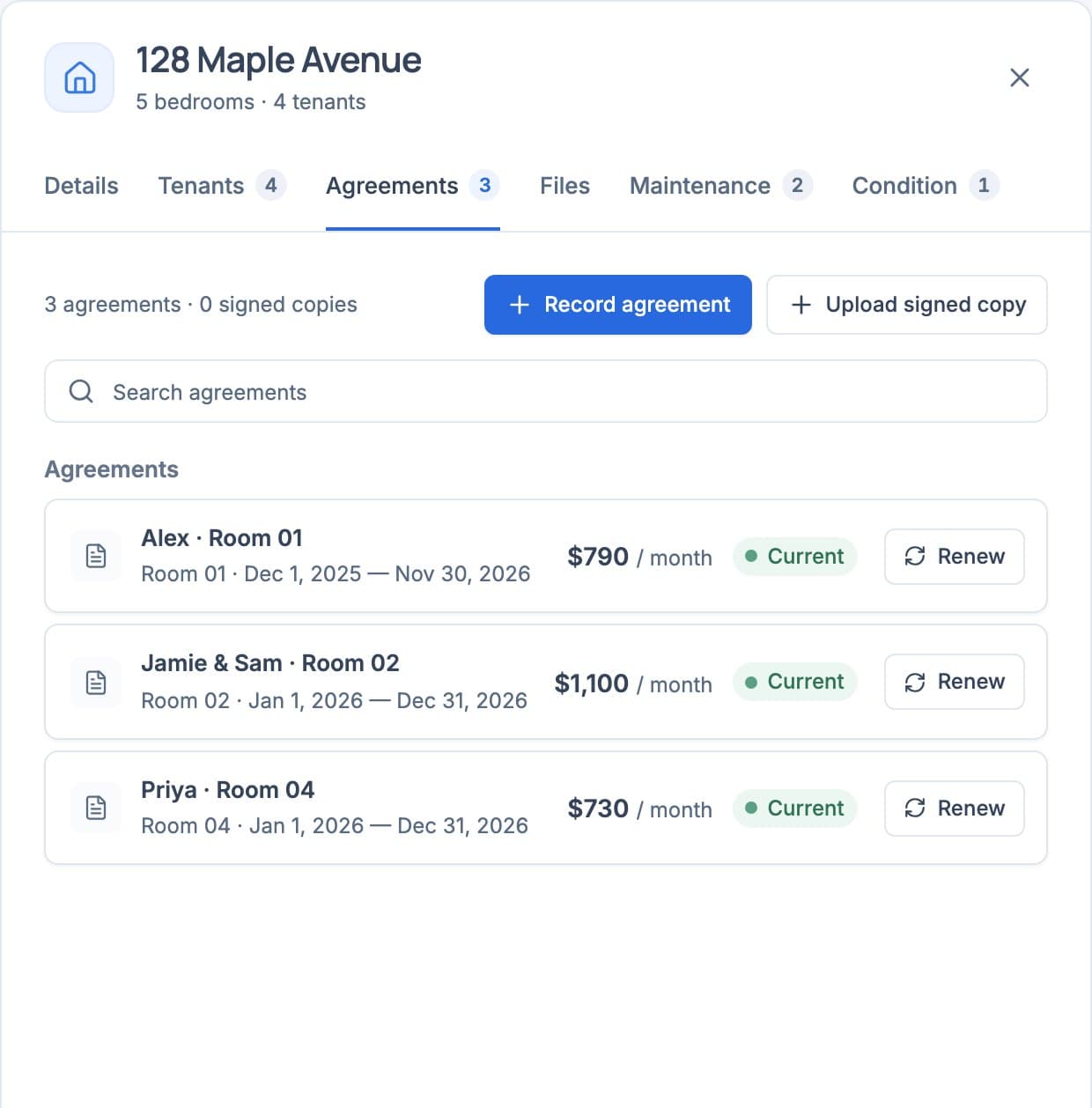
Our example is an upgrade, and a hypothetical one. Say Priya, who rents the 136 sq ft Room 04 at $730 a month, asks to move into Room 03, the 150 sq ft room that has been sitting empty at $765. She moves on Saturday, September 12. Room 04 then becomes the room you list.
Before you agree, check that the move is good for the house and not only for one resident. A move that fills one room but leaves a smaller one empty through winter may cost more than it gains. The cost of an empty week is worked out in our room turnover guide.
Prorate the rent difference by the day
Priya paid $730 for Room 04 on September 1. For the rest of September, the rent owed is the old rent for the days she was in Room 04 and the new rent for the days she’s in Room 03. Here the move day counts as the first day in the new room, so Room 04 covers September 1–11 (11 days) and Room 03 covers September 12–30 (19 days). September has 30 days.
The simplest way to get it right is to calculate only the difference and round once. The daily difference is $35 ÷ 30 = $1.1667, and 19 days of it is $35 × 19 ÷ 30 = $22.17. Priya owes $22.17 on top of the $730 she has already paid, for a September total of $752.17. From October 1 her rent is $765.
As a check, calculate each room separately: 11 days in Room 04 is $730 × 11 ÷ 30 = $267.67, and 19 days in Room 03 is $765 × 19 ÷ 30 = $484.50. Those add to $752.17 as well; the two methods happen to agree here, but with other rents the per-line rounding can add a cent. The exact total is $22,565 ÷ 30 = $752.1667, which rounds to $752.17. Round once, at the end.
Some agreements prorate using the actual days in the month, as here, and others use a fixed 30 days or a yearly daily rate. Use whatever your agreement says, write the method in the new agreement, and give the resident the arithmetic in writing before the move.
| Line | Arithmetic | Amount |
|---|---|---|
| Room 04 monthly rent | Current agreement | $730.00 |
| Room 03 monthly rent | Asking rent while empty | $765.00 |
| Monthly difference | $765 − $730 | $35.00 |
| Daily difference | $35 ÷ 30 days | $1.1667 |
| Days in Room 03 | September 12–30, inclusive | 19 |
| Extra rent for September | $35 × 19 ÷ 30 | $22.17 |
| Already paid September 1 | Full month for Room 04 | $730.00 |
| September total | $730.00 + $22.17 | $752.17 |
| October onward | New agreement | $765.00 |
Decide what happens to the deposit
Say Priya paid a $730 deposit, one month’s rent, when she moved into Room 04. There are two common ways to handle it. You can carry it over: the same money now secures the Room 03 agreement, and if your practice is one month’s rent, you ask for a $35 top-up. Or you can settle it: do a full move-out inspection of Room 04, account for it as if she had left, and take a new deposit for Room 03.
Carrying it over is simpler and is what most residents expect. Settling it is cleaner if Room 04 has damage you’d want to deduct, because the evidence and the deduction stay tied to the room where the damage happened. Either way, write down which one you chose and the amounts, and have the resident acknowledge it.
Deposit limits, how deposits must be held, and what counts as a return are set by state and sometimes city law, and some places cap deposits at a multiple of the rent. Check whether a top-up is allowed and whether moving rooms counts as ending a tenancy where your property is. This guide is not legal advice; ask a local landlord–tenant professional if you’re unsure.
Record the condition of both rooms
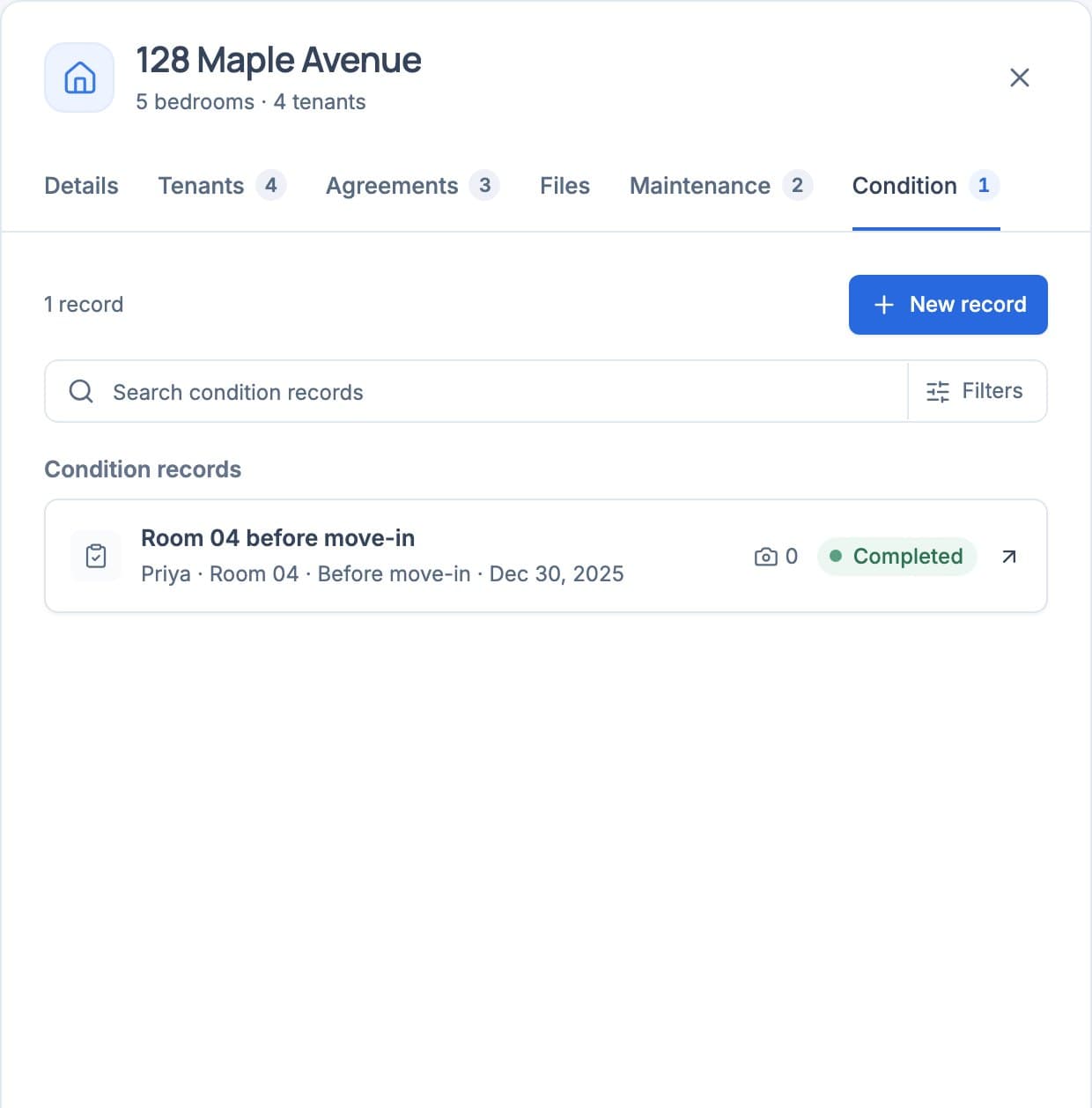
A room move is a move-out and a move-in on the same day, and it needs both records. Walk Room 04 with Priya after she has moved her things out, with dated photos, and record it as a move-out. Then walk Room 03 before or as she moves in, and record it as a move-in. That second record is her new baseline, and it should show the room after any cleaning or repairs since it was last let.
Don’t skip the Room 04 record because she’s staying in the house. If a mark on the Room 04 wall turns up in six months, you’ll want to know whether it was there when Priya left or appeared under the next resident. And if you carry the deposit over, the Room 04 move-out record is the only evidence of how she left that room.
End the old agreement and start a new one
It’s tempting to open Priya’s agreement, swap Room 04 for Room 03, and change the rent. Don’t. That rewrites the past: the record would now say she rented Room 03 at $765 from the day she first moved in, Room 04 would show no resident for that period, and the move-in photos filed with it would belong to a room the agreement no longer names.
Instead, end the Room 04 agreement on the last day she was in that room, September 11, and record a new agreement for Room 03 starting September 12. The old agreement keeps its room, rent, deposit, and condition records as history. The new one carries the new room, the new rent, the deposit arrangement you chose, and a note on the September proration. Attach a signed copy of the new agreement, or of a signed room-change addendum if that’s what your attorney recommends, and the house-rules addendum.
If the old agreement has a fixed end date, the new one can end on the same date or start a fresh term. Whichever you choose, the new agreement is where the terms live from now on.
- Room 02Stable space
- AgreementDates, rent, terms
- Jamie + SamPeople and shares
When they move outEnd the agreement and retain its evidence.
When someone moves inCreate a new agreement against the same room.
Tell the other housemates
The rest of the house doesn’t need to know the rent, but they do need to know what changes for them. Tell them before the move day: who is moving, which room, when, and that Room 04 will be shown to applicants. If you run viewings, give the dates and times the same way you would for any turnover.
Update the shared details that follow the room, not the person. The fridge shelf and cupboard labeled Room 04 either move with Priya or stay for the next resident; decide which and say so. Check the cleaning rota if any of its slots are tied to the room. Things tied to the person, such as a parking space, usually don’t change.
If the move came from a conflict, keep the message short and neutral. The other residents need logistics, not the reasons.
How Roomline keeps the history
In Roomline, a person is a separate record from their agreements, so Priya stays one person across both rooms. To end the Room 04 agreement on September 11 rather than today, open it, choose Edit agreement, set the End date, and set Agreement status to Ended; End agreement on its own closes an agreement on today’s date. Ended agreements stay in history with their rent already recorded, files, and condition records.
Then record a new agreement for Priya covering Room 03 from September 12, with the $765 monthly rent, the deposit, and a note on the proration. Roomline won’t save two active agreements that cover the same room on overlapping dates, so the Room 04 agreement has to end before the new one begins. On the board and floor plan, Room 03 shows Occupied once her active agreement covers today, and Room 04 shows Available until you record the next agreement for it.
Record the Room 04 move-out condition record against the old agreement and the Room 02 move-in record against the new one, each with photos, notes, and a rating of Good condition, Existing wear, or Needs attention. Compare puts two records side by side, so the Room 04 move-in and move-out can be checked area by area. Parking is assigned to the person, not the room, so a resident who has a space keeps it without any change.
Roomline doesn’t prorate rent. If you use rent rules for bank matching, add one to the new agreement; rent status expects each agreement’s full monthly rent for every month it covers, so September on the new agreement will show as part-paid after you record the $22.17. The note on the agreement explains why. Roomline also doesn’t hold deposits or collect signatures; record the results of those here.
The room move checklist
Work through these in order. Most can be done in the week before the move, which leaves the move day for keys, photos, and boxes.
- Agree the move date in writing, and confirm the new room is free by then
- Calculate the prorated rent for the split month, round once, and send the arithmetic
- Decide whether the deposit carries over or is settled, and record the amounts
- Check local deposit and notice rules before asking for a top-up
- Record the move-out condition of the old room, with dated photos
- Record the move-in condition of the new room after cleaning and repairs
- End the old agreement on the last day in the old room; don’t edit its rooms
- Record a new agreement for the new room, with the new rent and a proration note
- Attach the signed agreement or addendum and the house rules to the new agreement
- Move or reassign keys, the fridge shelf, the cupboard, and the cleaning rota
- Tell the other housemates the date and any viewing times for the old room
- Price and list the old room as a normal turnover
Common questions
How do I prorate rent when a tenant moves to a different room?
Take the difference between the two rents, multiply by the days in the new room, divide by the days in the month, and round once at the end. Moving from $730 to $765 on September 12 gives $35 × 19 ÷ 30 = $22.17 on top of the $730 already paid. If your agreement names a proration method, use that one.
Do I need a new lease when a tenant switches rooms?
A new agreement, or a signed room-change addendum, is usually cleaner than editing the old one, because the room, rent, and deposit terms all change. End the old agreement on the last day in the old room and start the new one the next day, so each room’s history stays accurate. Whether a room change legally ends a tenancy depends on local law; this is not legal advice.
Can I ask for a larger deposit when a tenant moves to a more expensive room?
Often, if your agreement and local law allow it. If your practice is one month’s rent, moving from a $730 room to a $765 room means a $35 top-up. Many states and cities cap deposits or regulate how they’re held, so check yours first; this is not legal advice.
Should I inspect the old room when a tenant moves within the house?
Yes. Record a move-out for the old room and a move-in for the new one, with dated photos, even when both happen the same day. If you carry the deposit over, the old room’s move-out record is your only evidence of how the resident left it.