The overnight guest in Room 03 has been there seventeen nights, and nobody signed anything that says that’s not allowed. In a rent-by-the-room house, most arguments aren’t about rent. They’re about a guest who never left, a fridge shelf nobody owns, or what happens to the utility split when a room empties. Those answers need to be written down before move-in, and they need to live in the right document. This checklist sorts the usual topics into the per-room agreement, a house-rules addendum, or both, using the fictional five-bedroom Maple House from our other guides.
Put the room, money, dates, deposit, and exit terms in each agreement, put day-to-day rules in one addendum every resident signs, and have a local attorney review both.
Two documents, two jobs
The per-room agreement is the contract for one room. It names the resident or residents, the room they rent, the dates, the rent and each person’s share, the deposit, and how either side ends it. Those terms shouldn’t change in the middle of an agreement unless both sides agree in writing.
The house-rules addendum describes how the shared house runs day to day: guests, quiet hours, cleaning, the kitchen, parking, and smoking. Every resident should get the same addendum, attached to their own agreement and signed or acknowledged with it. Everyone shares the same kitchen, so everyone should be working from the same rules.
Some topics belong in both. The agreement should say that the house rules are part of it and what happens when they’re broken; the addendum carries the detail. A rule that only lives in the house group chat is hard to rely on later.
Not legal advice: check your local rules first
Landlord–tenant law and occupancy rules vary by state, county, and city. Security deposit limits and return deadlines, required notice periods, when and how you may enter a resident’s room, guest and occupancy limits, smoking rules, and even whether a rent-by-the-room arrangement is treated as a tenancy or a lodging arrangement can all differ. Some cities also limit how many unrelated people can share a house or require a rooming-house license, and UK councils license many shared houses as HMOs (houses in multiple occupation).
This checklist organizes the topics; it doesn’t tell you what is allowed where your property is. Have a local landlord–tenant attorney review your agreement and addendum before you use them, and again when the law changes. Treat every example wording below as a starting point for that conversation, not as ready-to-use lease language.
The checklist: what goes where
Here is how the common topics sort out. The rule of thumb: if it’s about money, dates, the space someone rents, or how the arrangement ends, it goes in the agreement. If it’s about how people share the house, it goes in the house rules. If it’s both, the agreement sets the term and the addendum explains how it works.
| Topic | Put it in | Why |
|---|---|---|
| Room assignment | Agreement | The covered room is a core term; use the house’s stable name, such as Room 02 |
| Rent, each person’s share, due day | Agreement | Money terms shouldn’t change because the house rules were updated |
| Security deposit per room | Agreement | Each agreement holds its own deposit, so one room’s deductions never touch another’s |
| Term and notice period | Agreement | Dates and how much notice each side gives are contract terms; check local minimums |
| One co-resident leaves a shared agreement | Agreement | Who owes the full rent after one person leaves must be settled before it happens |
| Access and entry for repairs | Agreement | Notice before entering a resident’s room is often set by law |
| Utilities: split method and cap | Both | The agreement says what’s included and the cap; the addendum explains the method |
| Shared spaces | Both | The agreement grants use of named shared areas; the addendum sets how they’re used |
| Parking | Both | A paid space is its own charge; the addendum covers visitor parking |
| Pets | Both | Permission is an agreement term; shared-area rules go in the addendum |
| Smoking and vaping | Both | Where it’s banned and the consequence; some cities regulate this directly |
| Move-out condition | Both | The agreement ties deductions to the deposit; the addendum lists the cleaning standard |
| Guests and overnight stays | House rules | An unlimited guest becomes an unlisted occupant sharing everyone’s bathroom |
| Quiet hours | House rules | One rule for everyone, easier to revisit at renewal than a lease term |
| Cleaning rota | House rules | Shared-area cleaning is a routine; say what any paid cleaner covers |
| Kitchen and fridge space | House rules | One labeled shelf per room ends most kitchen arguments |
Write rules with numbers in them
A rule like be considerate about guests can’t be applied consistently, and it’s the consistency that makes a rule fair. Give each rule a number, a time, or a place, so any resident can tell whether it has been broken without asking you.
Pets and smoking need extra care. Assistance animal rules can override a no-pets policy, and some cities restrict smoking in multi-occupant housing. Ask your attorney how to word both.
- Quiet hours with times, for example 10 p.m. to 7 a.m. Sunday through Thursday
- Guests with a limit, for example no more than three nights in a row without the landlord’s written approval
- Cleaning rota by area and week, posted where everyone sees it
- Kitchen: one fridge shelf and one cupboard per room, labeled with the room name
- Utilities: included up to a stated house cap, with the overage method written out
- Parking: which spaces are assigned and where visitors may park
- Move-out: the cleaning standard, key return, and when the walkthrough happens
- Changes: how and with how much notice the house rules can be updated
Decide now what happens when one housemate leaves
With separate agreements per room, one departure is simple. When Priya’s Room 04 agreement ends, only that agreement ends. The other four residents' rent, deposits, and dates are unaffected, and the landlord covers Room 04's share of the utilities while it’s empty.
A shared agreement needs a written answer in advance. Room 02 is let to Jamie and Sam on one $1,100 agreement, $550 each. If Sam leaves, does Jamie owe the full $1,100? Can Jamie propose a replacement, and does the landlord have to approve them? Is the deposit held against the whole agreement until it ends? A common approach is to end the shared agreement and start a new one, for example Jamie alone at Room 02's $1,025 single-occupancy rent, rather than editing names on the old one.
Say in the agreement that residents can’t sublet or move someone new in without written approval. Otherwise the house can gain a resident you never agreed to.
- Room 02Stable space
- AgreementDates, rent, terms
- Jamie + SamPeople and shares
When they move outEnd the agreement and retain its evidence.
When someone moves inCreate a new agreement against the same room.
Keep the agreement and the rules together in Roomline
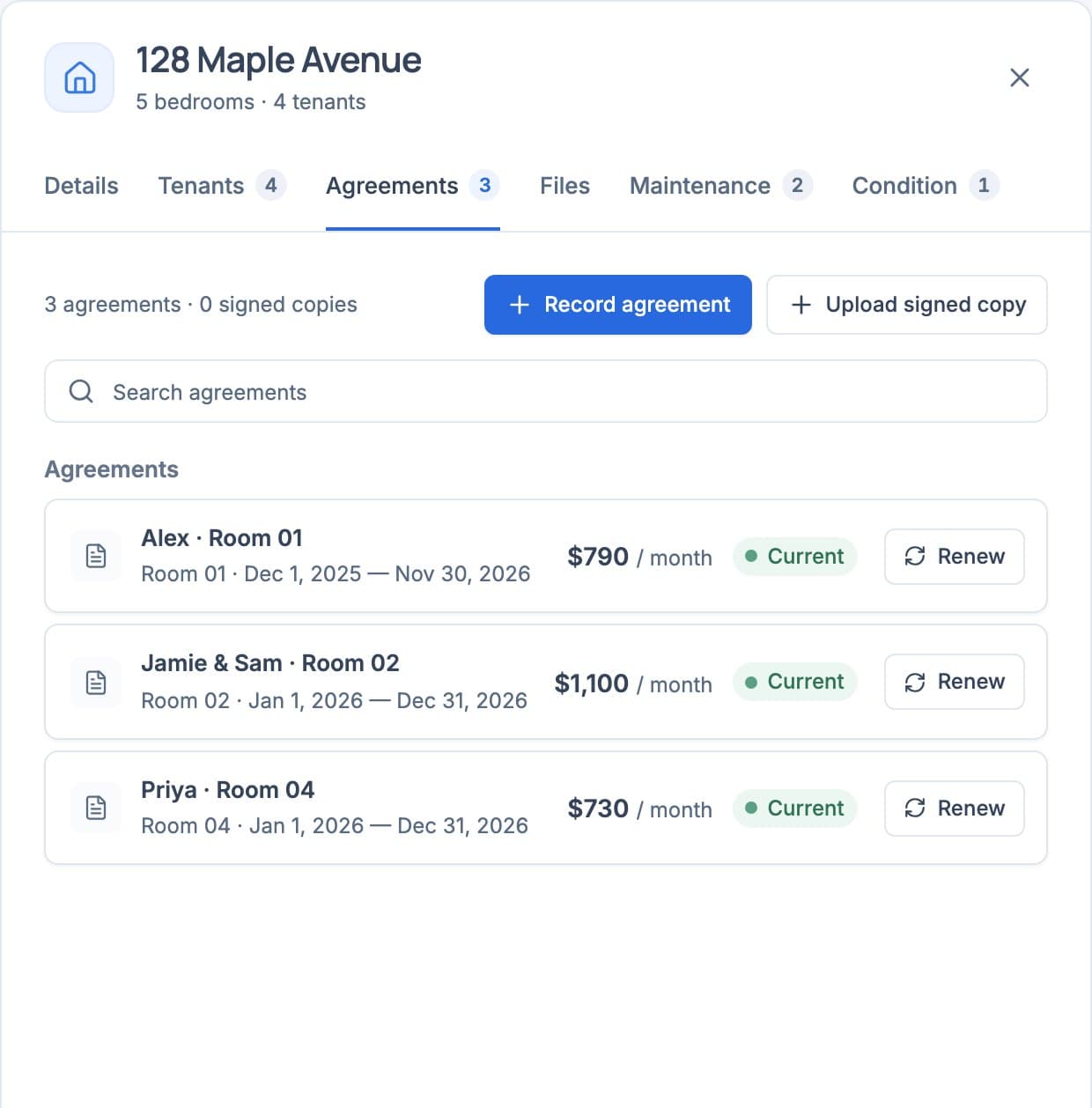
In Roomline, each rental agreement records the rooms it covers, its residents, start and end dates, monthly rent, security deposit, and each resident’s monthly share; the shares must add up to the agreement total. Its Additional details step has fields for rent due day, a notice reminder in days before the end date, the signed-on date, Utilities, House rules, and an emergency contact, so a short summary of the arrangement sits right on the agreement.
Attach the signed agreement and the house-rules addendum to the agreement as documents; Addendum is one of the document categories. Record move-in and move-out condition with photos for the room and any named shared areas, and compare the two records area by area when the resident leaves.
Roomline doesn’t provide agreement or house-rules templates, draft leases, or collect signatures. Use the documents your attorney reviewed and the signing method you already use, then record the result. The notice reminder is a planning date, not legal notice.
| Record | Belongs to | Example |
|---|---|---|
| Signed agreement | The agreement | Room 02 agreement, Jamie and Sam |
| House rules addendum | The agreement | Attached and signed with each resident’s agreement |
| Move-in photos | Condition record, by area | Room 02 and the upstairs bathroom |
| Fire safety certificate, licenses | The property | Annual inspection report |
| Utility bills | The property | Monthly bills as documents |
- Agreement: rooms, residents, dates, rent, deposit, and each member’s share
- Additional details: notice reminder days, Utilities, and House rules
- Documents: the signed agreement and the addendum, filed on the agreement
- Condition records: move-in and move-out, by room and shared area
Common questions
What should house rules for a rent-by-the-room house include?
Cover how people share the house: guests and overnight stays, quiet hours, the cleaning rota, kitchen and fridge space, parking, smoking, and how the rules can change. Give each rule a number, time, or place, such as quiet hours from 10 p.m. to 7 a.m. Sunday through Thursday. Have a local attorney review the addendum, because what you can require varies by location.
Are house rules legally enforceable?
They’re easiest to rely on when they’re attached to each resident’s agreement, the agreement says the house rules are part of it, and each resident signs or acknowledges them. Whether a specific rule is enforceable depends on your state and city, and topics like entry, guests, and assistance animals are often regulated. This is not legal advice; have a local landlord–tenant attorney review them.
How long can a guest stay in a rent-by-the-room house?
Set a specific limit in the house rules, for example no more than three nights in a row without the landlord’s written approval. Without one, a frequent guest can become an unlisted occupant sharing everyone’s bathroom and utilities. Some places limit what guest rules can require, so check local law.
What happens to the rent when one person on a shared room agreement moves out?
Decide in writing before it happens. On a shared $1,100 agreement split $550 each, say whether the remaining resident owes the full amount, whether they can propose a replacement you approve, and how the deposit is handled. A common approach is to end the shared agreement and start a new one, such as the remaining resident alone at the $1,025 single-occupancy rent.