It’s the 6th, and the house group chat already has fourteen messages about who ran the space heater in Room 03 all February. Utilities cause more arguments in shared houses than rent does: rent is a fixed number in an agreement, the electric bill changes every month, and everyone has a theory. The fix isn’t a perfect formula. It’s picking a method that fits your house, writing it down before anyone moves in, and applying it the same way every month. This guide compares four common methods using one real-looking bill at Maple House.
Pick one method, write it into every agreement before move-in, and apply it the same way every month, including when a room is empty.
Know what you are splitting
List every utility, who the account is with, and whose name it’s in. In most rent-by-the-room houses the landlord holds the accounts, because residents come and go on different dates and nobody wants to transfer the internet every time Room 03 turns over.
Our example is the same fictional five-bedroom Maple House used in our room pricing guide. In an average month the bills come to $480: electric $210, gas $95, water and sewer $80, trash $30, and internet $65. Room 02 is let to a couple, so there are six residents across five rooms.
Use a twelve-month average when you set a fixed amount. A single January gas bill can be twice a July one, and a number set in summer will leave you short in winter.
Four methods, one bill
Equal per room is the simplest: divide by the number of rooms. It’s easy to explain, but the couple in Room 02 pays the same as one person in Room 05. Per occupant fixes that by dividing by people instead. By room size charges bigger rooms more, which matches how the rent was set but has little to do with who uses the dryer.
The all-inclusive method builds utilities into the rent up to a cap for the whole house. Residents pay nothing extra in a normal month. If the house goes over the cap, the overage is split and billed later. At Maple House the cap is $550 for the house. In a January with a $640 bill, the $90 overage is $18 per room.
| Method | Room 01 | Room 02 (2 people) | Room 03 | Room 04 | Room 05 |
|---|---|---|---|---|---|
| Equal per room | $96.00 | $96.00 | $96.00 | $96.00 | $96.00 |
| Per occupant (6 people) | $80.00 | $160.00 | $80.00 | $80.00 | $80.00 |
| By room size (780 sq ft) | $98.46 | $131.69 | $92.31 | $83.69 | $73.85 |
| Included, $550 house cap | $0 | $0 | $0 | $0 | $0 |
| Included, $640 January bill | $18.00 | $18.00 | $18.00 | $18.00 | $18.00 |
Which method fits which house
For most rent-by-the-room houses, an all-inclusive fee with a cap is the least friction. Residents budget one number, you don’t send five small bills every month, and the cap protects you from the resident who heats the house to 78 degrees. The trade-off is that you carry the risk below the cap, so the included amount belongs in your rent pricing.
Per occupant works well when rooms hold different numbers of people. Equal per room suits houses where every room is similar and single-occupancy. By room size is the hardest to defend, because a bigger bedroom doesn’t use more hot water; use it only when the size difference is large and rents were also set by size.
- All rooms similar, one person each: equal per room
- Couples or shared rooms: per occupant
- Frequent turnover or mixed tenants: included with a cap
- Residents want to see every bill: equal or per occupant, with copies attached
Pitfalls that cause disputes
Empty rooms are the most common one. If Room 04 is vacant for a month and you divide the bill by the four remaining rooms, everyone’s share jumps from $96 to $120 through no fault of their own. The usual fair answer is that the landlord covers the vacant room’s share.
Mid-month move-ins and move-outs should be prorated by days. If Room 01 moves in on the 16th of a 30-day month, that room owes 15/30 of its normal share, or $48 under the equal method.
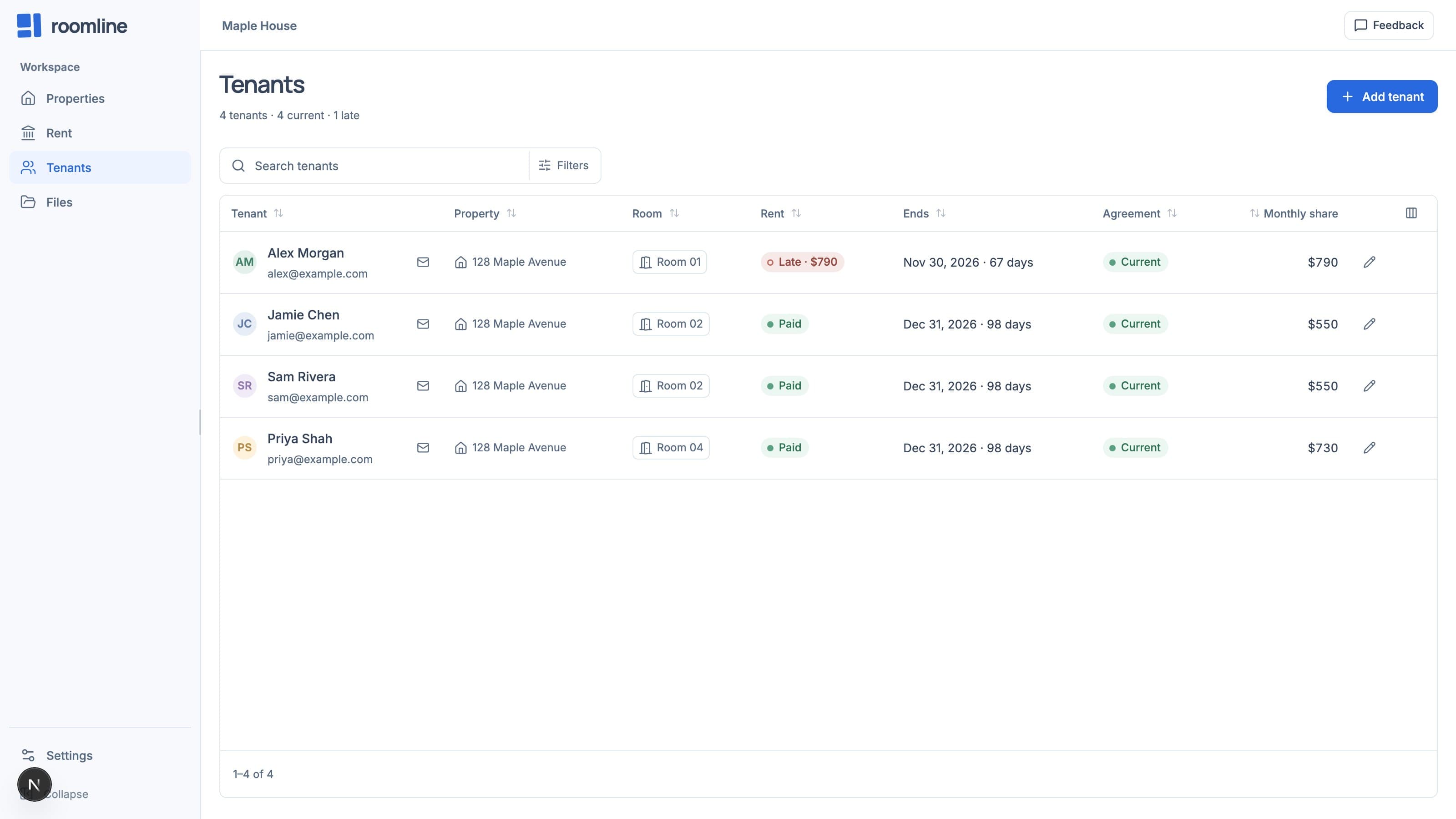
Keep utility charges separate from rent in your records. If a resident pays rent and a utility share together, you want to see that the rent was paid in full and the utility share was paid, not one combined number that makes both look settled.
Rules on billing residents for utilities vary by state and city. Some places regulate how landlords can pass through or resell utilities, whether submeters are required, or what has to be disclosed. Check your local rules, or ask a local professional, before you choose a method. This guide is not legal advice.
| Record | Amount | Rent still due |
|---|---|---|
| Expected rent | $1,100 | $1,100 |
| Jamie’s receipt confirmed | $550 | $550 |
| Sam’s receipt confirmed | $550 | $0 |
| Separate parking charge | $75 | $0 · not rent |
Write the method into the agreement
Whatever method you choose, write it down in plain words before move-in: which utilities are included, how the split works, when bills are shared, when payment is due, how vacancies and partial months are handled, and what happens above any cap. A resident who agreed to the method in writing rarely argues about the arithmetic later.
Roomline’s rental agreement has a Utilities field for exactly this, described in the form as what’s included or paid separately, next to the house rules. Attach copies of the bills to the property as documents so the numbers can be checked. Roomline keeps the house’s bills beside the arrangement — what the rent includes, what is split and each tenant’s share — along with the evidence; it never bills tenants or moves money.
- Which utilities are included and which are split
- The method: equal, per occupant, by size, or included with a cap
- How vacant rooms and partial months are handled
- When bills are shared and payment is due
- Where residents can see copies of the bills
Utility split calculator
Enter one month’s bill and pick a method. Equal splits it by room, per occupant weighs by who’s living there, and by size weighs by bedroom square footage.
| Room | Occupants | Size (sq ft) | Share |
|---|---|---|---|
| $96.00 | |||
| $96.00 | |||
| $96.00 | |||
| $96.00 | |||
| $96.00 | |||
| Total | $480.00 | ||
Common questions
Is it legal to charge tenants for utilities in a shared house?
In many places landlords can pass utility costs through, but rules on reselling utilities, submetering, and required disclosures vary by state and city, and some places restrict dividing a master-metered bill between residents. Check your local rules or ask a local landlord–tenant professional before choosing a method. This is general information, not legal advice.
Who pays the utilities for an empty room?
The usual fair answer is the landlord. If Room 04 at Maple House is empty and you divide a $480 bill among the four remaining rooms, each share jumps from $96 to $120 through no fault of those residents. Write the vacancy rule into the agreement before move-in so nobody is surprised.
How do I split utilities when someone moves in mid-month?
Prorate by days. A resident who moves in on the 16th of a 30-day month owes 15/30 of the normal share, which is $48 under Maple House’s $96 equal share. Use the same rule for move-outs and write it into the agreement.
What is a fair utility cap for a rent-by-the-room house?
Base it on a 12-month average of your bills, then leave headroom for winter. Maple House averages $480 a month and sets a $550 house cap; in a $640 January, the $90 overage is split at $18 per room. A cap set from one summer bill will leave you short.