Five listings, five guesses, and Room 05 still sits empty three weeks in at 128 Maple Avenue, because it’s priced the same as Room 01, which is forty square feet bigger. Most room rents get set by eyeballing a few listings and picking a number that feels right, and that works until the rooms stop adding up to what the house actually costs to run. A better method starts from the whole house, then divides it fairly. Below is the method step by step, using the fictional five-bedroom Maple House, with numbers you can replace with your own.
Price the house first, add a vacancy buffer, then split the target by shared value, room size, and fixed premiums so the rooms always add up.
Start with a whole-house target, not room listings
Work out two numbers before you look at a single room listing. The first is your cost floor: what the house costs per month with every room let. The second is a market check: what the same house would rent for as one unit. The room rents you set should clear the first and, in most markets, land above the second, because renting by the room means more turnover, more furnishing, and more of your time.
| Line | Monthly | Notes |
|---|---|---|
| Mortgage, taxes, insurance | $2,450 | Use your actual statements |
| Utilities included in rent | $480 | 12-month average, not one bill |
| Repairs and replacement reserve | $250 | Furniture, appliances, paint |
| Shared-area cleaning | $120 | Twice a month |
| Household supplies | $80 | Paper goods, bulbs, filters |
| Owner cushion | $300 | Your margin, not a market fact |
| Needed in an average month | $3,680 | Before the vacancy buffer |
Add a vacancy and turnover buffer
Rooms turn over more often than whole houses, and every changeover costs some empty days, cleaning, and your time. If you price so that the house only works at 100% occupancy, the first empty room puts you under water. Divide what you need by the occupancy you realistically expect instead.
Weight each room, then check the total
Rooms aren’t equal, so their rents shouldn’t be. A simple way to be fair is to take fixed premiums off the top, then split what is left into two halves. One half is shared equally, because everyone gets the same kitchen, living room, and internet. The other half is split by bedroom size, because that’s the private space each person is paying for.
If only some rooms are furnished, treat furniture like the bathroom: a fixed premium taken off the top before the split. If every room is furnished, it doesn’t change the relative prices at all, only the cost floor.
| Room | Size | Equal share | Size share | Premium | Asking rent |
|---|---|---|---|---|---|
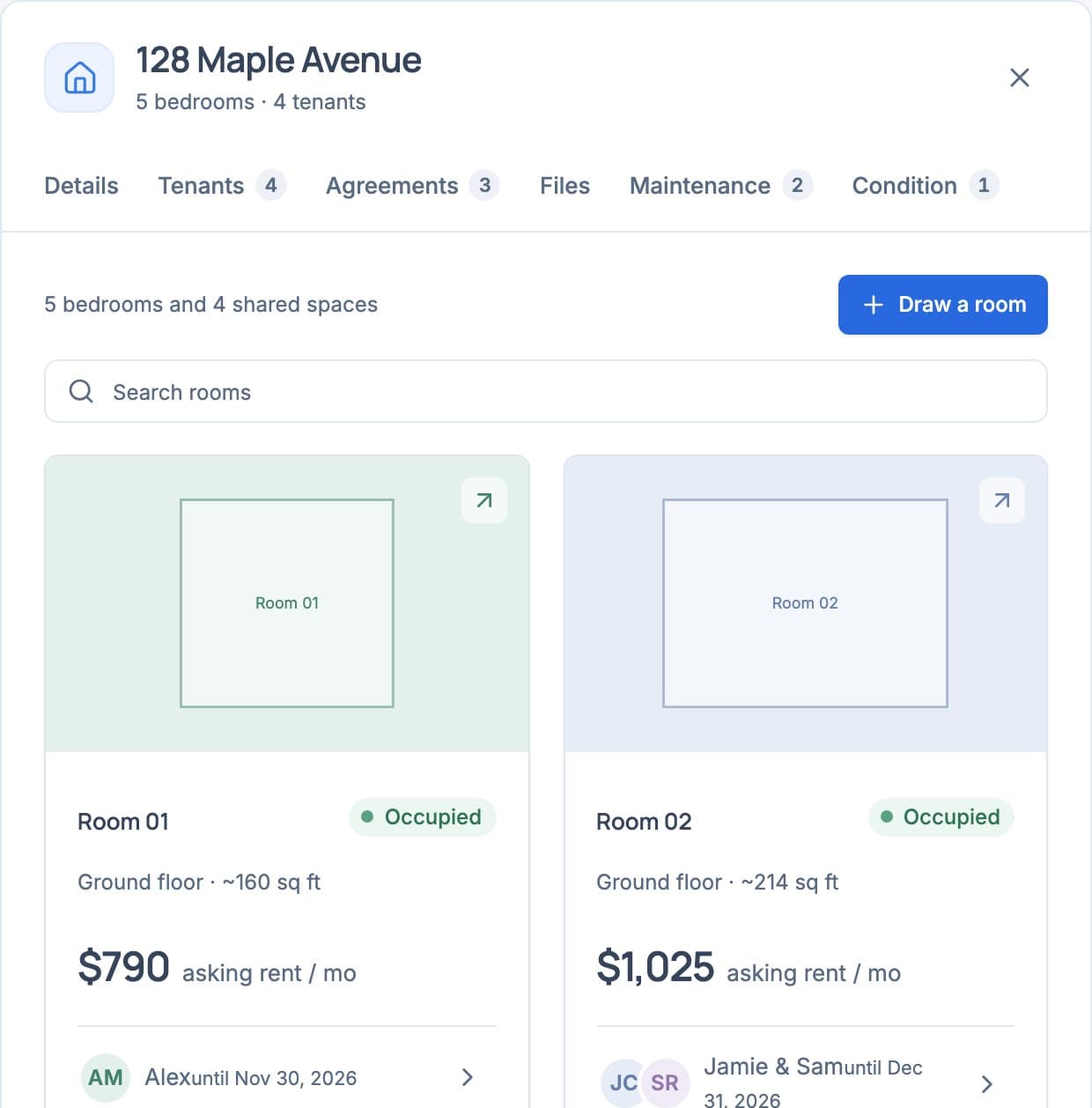
| Room 01 | 160 sq ft | $390 | $400 | — | $790 |
| Room 02 | 214 sq ft | $390 | $535 | $100 private bath | $1,025 |
| Room 03 | 150 sq ft | $390 | $375 | — | $765 |
| Room 04 | 136 sq ft | $390 | $340 | — | $730 |
| Room 05 | 120 sq ft | $390 | $300 | — | $690 |
| Total | 780 sq ft | $1,950 | $1,950 | $100 | $4,000 |
Sanity-check against local room listings
Now compare each room against current listings for similar rooms nearby: same neighborhood, similar size, shared or private bath, furnished or not. The formula makes the rooms fair relative to each other; the market decides whether the whole set is realistic.
If Room 05 at $690 is well above what small rooms nearby are going for, don’t just cut Room 05 and call it done. Either lower the target, which means accepting a thinner cushion, or change the weighting, for example by moving from a 50/50 split to 60% equal and 40% by size, which narrows the gap between the largest and smallest rooms. Then recheck that the total still clears your cost floor.
- Compare against rooms, not whole apartments
- Match shared vs. private bath and furnished vs. unfurnished
- Look at listings from the last few weeks, not last year
- Round to the nearest $5 or $10, then re-add the total
- Write down the method so the next price change uses the same logic
Utilities, parking, and a second person in a room
If two people share a room, add a second-occupant charge to cover extra utilities and wear rather than doubling the rent. If Room 02 goes to a couple, the agreement might be $1,025 plus $75, or $1,100, split $550 each, as in the example below.
| Record | Amount | Rent still due |
|---|---|---|
| Expected rent | $1,100 | $1,100 |
| Jamie’s receipt confirmed | $550 | $550 |
| Sam’s receipt confirmed | $550 | $0 |
| Separate parking charge | $75 | $0 · not rent |
Keep the prices where you manage the rooms
In Roomline, each room carries its own asking rent, and each agreement carries the contracted rent and each member’s share; the shares must add up to the agreement total. The floor plan colors every bedroom by status, occupied, available, or agreement pending, so an empty Room 05 at $690 is hard to miss.
Roomline plans are priced by property, with an included allowance of units or bedrooms, so a five-bedroom house is not billed as five separate rentals. Current plans and limits are on the pricing page.
Change asking rents between agreements rather than in the middle of one. Whether and how you can change rent during an agreement depends on its terms and your local rules.
Per-room rent calculator
Set the whole-house target, then each room’s size and any fixed premium (a private bath, say). The rents below always add back up to the target.
| Room | Size (sq ft) | Premium ($) | Asking rent |
|---|---|---|---|
| $790.00 | |||
| $1,025.00 | |||
| $765.00 | |||
| $730.00 | |||
| $690.00 | |||
| Total | $4,000.00 | ||
Common questions
Should utilities be included in room rent?
Including them is usually simpler in a shared house: residents pay one predictable number and you avoid splitting small bills five ways every month. Build a 12-month average into your cost floor, as Maple House does with $480 a month, and consider a house cap so heavy use doesn’t eat your margin. If residents pay separately instead, take utilities out of the target; at Maple House it drops to about $3,510.
How do I price a room with a private bathroom?
Treat the bathroom as a fixed premium taken off the top before you split the rest by shared value and size. At Maple House the private bath is worth $100 locally, so Room 02 is $390 equal share plus 214 sq ft at $2.50, plus $100, for $1,025. Check the premium against local listings for rooms with and without a private bath.
How do I build a vacancy buffer into room rents?
Divide what the house needs each month by the occupancy you realistically expect. Maple House needs $3,680 and plans for 92% occupancy, so $3,680 ÷ 0.92 = $4,000 is the full-occupancy target the rooms must add up to. At 92%, that allows about one empty month per room per year; use your own turnover history once you have it.
How much should I charge a couple sharing one room?
Add a second-occupant charge for the extra utilities and wear rather than doubling the room’s rent. At Maple House, Room 02 at $1,025 plus a $75 second-occupant charge becomes a $1,100 agreement, split $550 each. Check local occupancy limits before letting a room to two people.