Most landlord apps are built around money: collecting rent, banking it, and keeping the books for tax time. Some are built around finding tenants. Roomline is built around a different job: keeping a rent-by-the-room house organized, room by room. This guide compares the popular apps plainly, what each does well and what it isn’t built for, so you can pick one, or two that work side by side. Facts about other apps come from their own sites, as of September 2026; prices change, so check before you sign up.
Pick a money app for rent, banking, and books if you need one; if you rent by the room, add something built to keep the rooms organized, and test both on your messiest house.
At a glance
The table covers the jobs that separate these apps most. Every app here does more than fits in a table, such as screening, maintenance requests, and tenant portals, so read the sections below before ruling one out.
| App | Rent | Banking | Books | Price |
|---|---|---|---|---|
| Baselane | Yes | Yes | Schedule E, free plan | Free; Smart $20/mo |
| TurboTenant | Yes | — | Accounting on Pro | Free; from $149/yr |
| Avail | Yes | — | Income and expenses | Free; Plus $9/unit/mo |
| RentRedi | Yes | — | Accounting | $12/mo |
| Stessa | Yes | Yes | Schedule E, paid plans | Free; from $12/mo |
| Landlord Studio | Yes | — | Schedule E, paid plans | Free to 3 units; Pro $12/mo |
| Roomline | No, records it | No | Income and costs export | $6, $12 or $29/mo |
Baselane and Stessa: banking and books first
Baselane is built around a landlord’s money. Its free Core plan includes business bank accounts through Thread Bank, Member FDIC (Baselane itself says it is not a bank), online rent collection, bookkeeping, and Schedule E reports. ACH rent payments carry a $2 fee that the landlord can cover or pass on, and card payments a 3.49% fee paid by the tenant. Smart, $20 a month billed yearly, adds automation such as auto-tagging and receipt matching.
Stessa is bookkeeping first. Its free Essentials plan includes bank feeds and basic financial reports, plus cash accounts through Thread Bank, online rent collection, tenant screening, and maintenance requests. Schedule E reports come with Manage, $12 a month billed yearly, and Pro, $28.
What neither is built for: the day-to-day of a shared house. Their pricing pages cover accounts, payments, and reports, not floor plans, shared spaces, a bill split between housemates, or move-in photos by room. If money is your hard part, start here. For how Baselane and Roomline can sit side by side, see our Baselane guide.
TurboTenant, Avail and RentRedi: find tenants and collect rent
TurboTenant is strong at filling a vacancy. Its free plan includes listings, screening paid by the renter, and rent collection; Essentials, from $149 a year for 1–10 units, adds lease creation and e-signing, and Pro, from $199 a year, adds income verification, free ACH payments, and accounting tools. It handles room rentals directly: you mark a property as having room rentals, and each room gets its own listing and target rent.
Avail covers the same ground for small landlords: free listings posted to many rental sites, state-specific lease templates with e-signing, screening, rent collection, and maintenance tracking. On the free plan tenants pay $2.50 per bank transfer; Unlimited Plus removes that fee for $9 per unit a month, so it grows with every room you set up as a unit.
RentRedi charges one flat price for unlimited units, $12 a month billed yearly or $29.95 month to month, and includes rent collection, screening paid by the renter, listings, accounting, maintenance requests, and a tenant app.
What these aren’t built for: banking, which none of them lists, and the shared parts of a rent-by-the-room house. Rooms can be set up as rentals or units, but their pricing pages don’t describe shared spaces, splitting a bill between housemates, or a floor plan.
Landlord Studio: accounting-first, priced per unit
Landlord Studio is strong on the books: bank feeds, AI-assisted bookkeeping, and Schedule E reports on its paid plans, plus rent collection, screening, listings, and e-signing. The free GO plan covers three units.
Its paid plans are per unit, which matters when each room is a unit. Pro is $12 a month for three units plus $1.20 for each extra unit. Two rent-by-the-room houses with 11 rooms set up as units come to $12 plus 8 × $1.20, or $21.60 a month. That’s still modest, but ask any per-unit app how it counts bedrooms before you set anything up.
PadSplit and SpareRoom: marketplaces, not management
PadSplit is a co-living marketplace. As a host you list rooms; PadSplit screens members, sets the membership rules, and takes its fees from what members pay: the first 10 days of each member’s stay plus 8% after that. It suits an owner who wants the rooms filled and run by someone else, and it means handing over much of the operation.
SpareRoom is a room listing site. One ad is always free; a Bold ad that ranks higher starts at $15 for seven days. It’s built for finding a housemate; rent, agreements, and records live elsewhere.
Where Roomline fits, and where it doesn’t
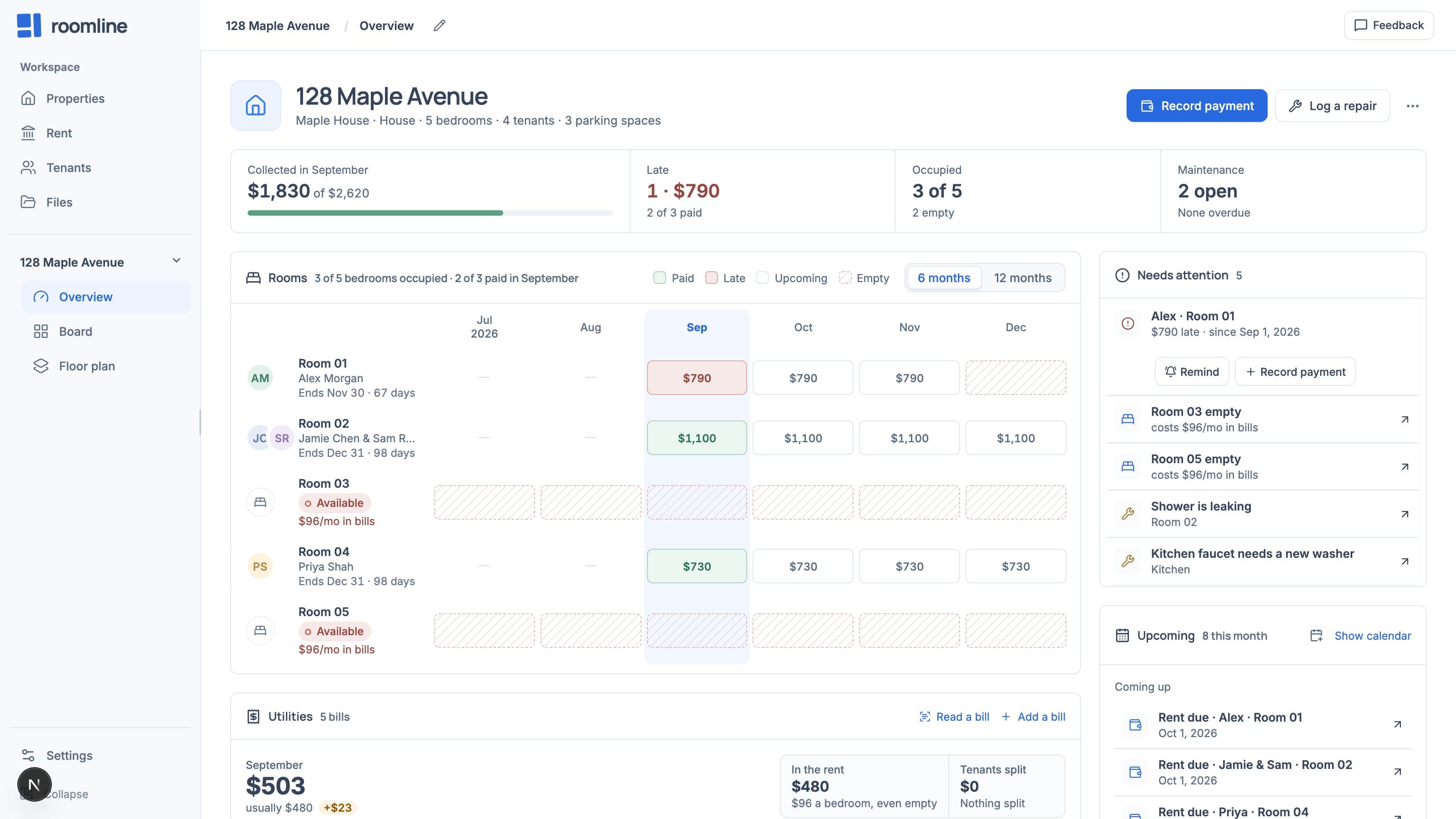
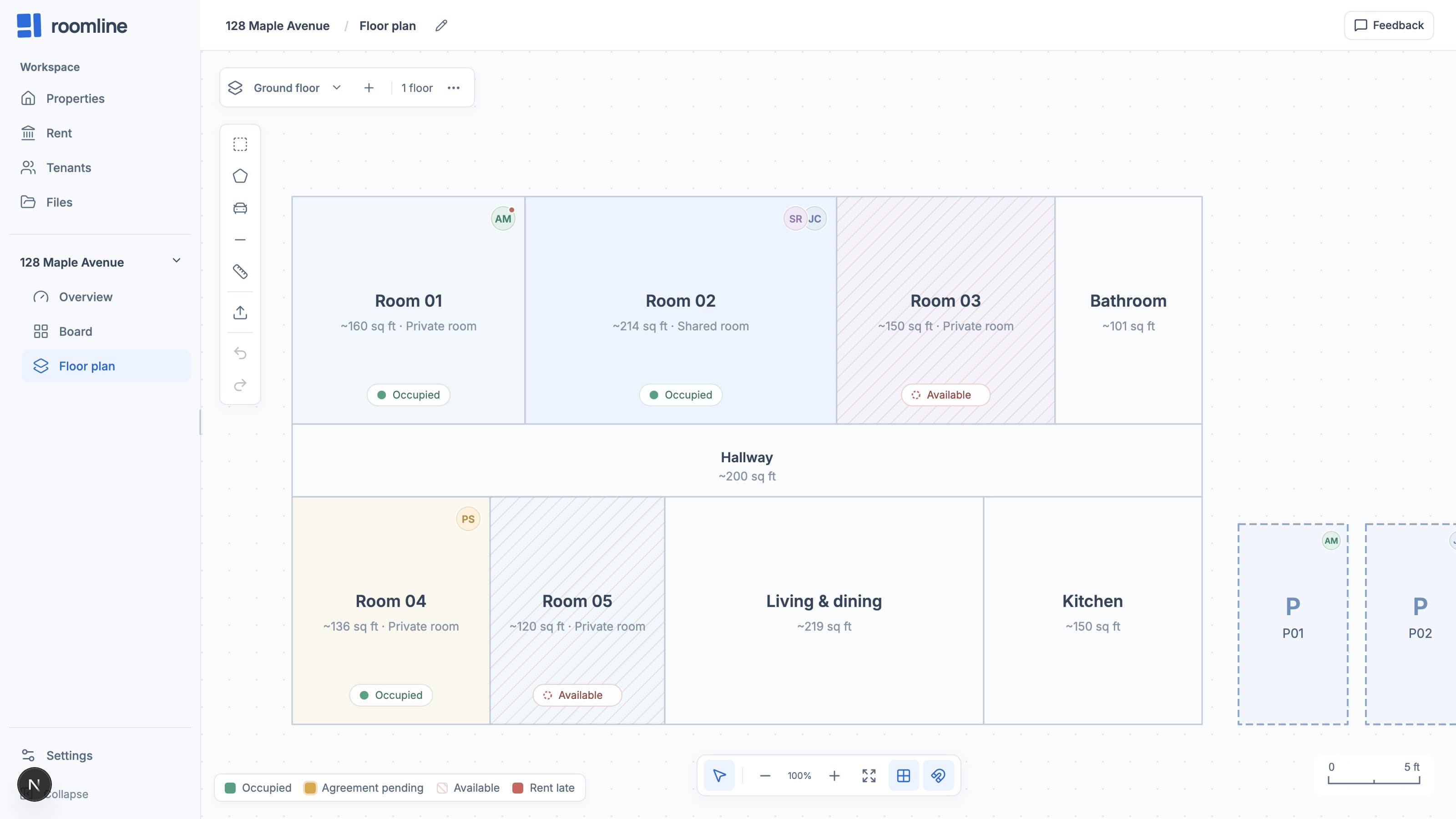
Roomline is the organizing layer for a rent-by-the-room house. Rooms sit on a floor plan and a board, each with its own asking rent and status. Each agreement covers a room, with every housemate’s monthly share, deposit, due day, and house rules. The rent ledger shows who has paid, room by room, from three sources: the tenant saying they’ve paid on their page, a payment you record, or read-only bank matching you confirm. Utilities are logged per house and either kept in the rent or split evenly between tenants. Repairs, move-in and move-out photos, and files sit with the room or agreement they belong to.
Each tenant gets a private page without an account: rent due with your pay links, their bill share, house rules, documents you share, repairs, and their deposit. Each room can have a listing page, and applicants you invite fill in an application. AI suggestions help with bills, leases, and bank deposits, and you can ask Claude or ChatGPT about your houses.
What Roomline doesn’t do: collect rent by ACH or card, hold deposits, provide bank accounts, keep the books or prepare tax reports, run screening reports, e-sign leases, or post your listing to other sites. If you need those, pair it with an app above; the money goes where it already goes, and Roomline keeps the rooms straight.
Pricing is flat by houses and bedrooms, never per tenant: Basic $6 a month for up to 2 houses and 8 bedrooms, Starter $12 for 5 and 25, Portfolio $29 for 20 and 200, with every feature on every plan and a 14-day trial with a card.
Which to pick
Choose by the job that takes most of your time. Many landlords will want one money app and, if they rent by the room, something to keep the rooms organized.
- Rent, banking, and books in one place: Baselane or Stessa
- Filling rooms and screening applicants: TurboTenant or Avail
- One flat price and a tenant app: RentRedi
- Accounting first, with bank feeds: Landlord Studio or Stessa
- Rather not run the house yourself: PadSplit
- Just need a housemate: SpareRoom
- Renting by the room, and keeping track is the hard part: Roomline, next to whichever app handles the money
Test any app on your messiest house
Demos use tidy apartments. Before you move more than one property, set up your hardest one in each app on your shortlist and see what it takes. A spreadsheet is still fine for one stable house kept by one person; it stops being enough when the same fact has to be copied across tabs, or you can’t say who lived in a room last year without digging.
- Five rooms at one address, each with its own agreement
- Two housemates on one agreement, with separate shares
- A shared kitchen or bathroom that isn’t filed under a bedroom
- Parking assigned to a person, not a room
- Last year’s agreement still findable after the room changes hands
- How the bill counts bedrooms, and what it costs when every room is full
Common questions
Does Roomline collect rent?
No. Tenants pay you directly by Zelle, Venmo, Cash App, PayPal, check, cash, or through another app, and Roomline records it: from the tenant’s “I’ve already paid” on their page, a payment you record, or a bank deposit you confirm. Roomline never holds or moves money.
Can I use Roomline alongside an app that collects rent?
Yes. Keep collecting rent where you do now and record what arrives in Roomline’s rent ledger, room by room. There is no official integration with Baselane, Stessa, or the others; the apps sit side by side. Our Baselane guide walks through one setup.
Which landlord app is best for renting by the room?
It depends on your hardest job. For collecting rent, banking, and books, Baselane or Stessa; for filling rooms and screening, TurboTenant or Avail. For keeping rooms, per-room agreements, shared bills, and repairs organized, Roomline, usually next to one of those. Test each on your messiest house before moving everything.
Is a spreadsheet good enough to manage a rent-by-the-room house?
For one stable house kept by one person, often yes: it’s free, flexible, and portable. It stops being enough when the same fact has to be copied across tabs, a room change means edits in several places, or you can’t say who lived in a room last year.